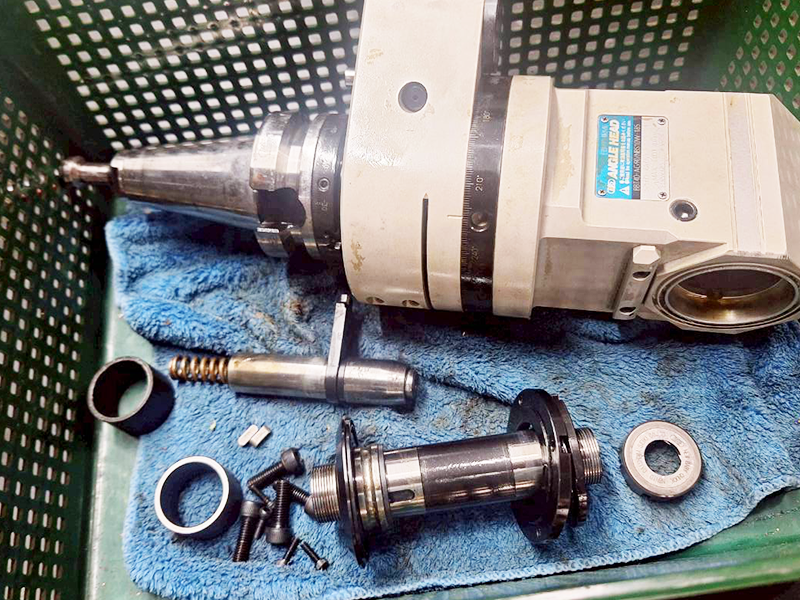
Angle Head Repair
Product Introduction
Loss of Precision in Angle Heads? The Key Lies in Professional Maintenance of Gear Systems and Sealing Structures
Angle Heads utilize precision spiral bevel gear mechanisms to redirect machining axes, providing machines with greater flexibility for side milling, deep cavity machining, and operations in confined spaces with interference.
Due to their compact internal structure and complex transmission paths, combined with high-torque and heavy-duty cutting loads, angle heads demand a higher technical threshold for repair and calibration compared to standard straight driven tool holders.
Product Description
Product trial model
Two Critical Keys to Angle Head Repair
1.Sealing System Degradation and Lubrication Failure
Angle heads operate at high speeds within confined spaces, placing extreme demands on lubrication and sealing.
When external oil seals age or wear out:
- Coolant may penetrate the interior and contaminate the lubricating grease.
- Lubricant emulsification reduces lubrication efficiency.
- Accelerated wear occurs in bearings and gears.
Conversely, if internal seals fail, lubricant leakage results in insufficient lubrication, subjecting the transmission system to abnormal friction and thermal loads.
Professional repair requires comprehensive inspection and the replacement of high-quality Fluoroelastomer (FKM) oil seals—which are resistant to high temperatures, oil, and chemical corrosion—to fully restore the lubrication system.
2.Wear of Bearings and Spiral Bevel Gears
The core transmission of an angle head relies on precision spiral bevel gears to redirect power. Under long-term, high-load operation, the following issues may occur:
- Gear surface wear
- Shifts in tooth contact patterns
- Increased backlash
The conditions mentioned above will directly impact:
- Dimensional stability of machining
- Surface roughness
- Operational noise
- Transmission efficiency
Professional repair is not merely about replacing bearings; the most critical aspects include:
- Precise measurement of gear contact surfaces
- Adjustment of gear preload and backlash
- Calibration of transmission concentricity
Through meticulous fine-tuning, we ensure smooth transmission without abnormal noise and restore the original machining precision.
The True Value of Professional Repair
The key to angle head repair lies in the reconstruction of "transmission geometric precision" rather than simple parts replacement. A complete repair process should include:
- Structural disassembly, cleaning, and inspection
- Evaluation of bearing and gear conditions
- Comprehensive renewal of the sealing system
- Calibration of transmission geometry
- Verification through runout and noise testing
Through standardized repair procedures and precision measuring equipment, we ensure the angle head restores stable operating conditions, extends its service life, and reduces the risk of unplanned downtime.