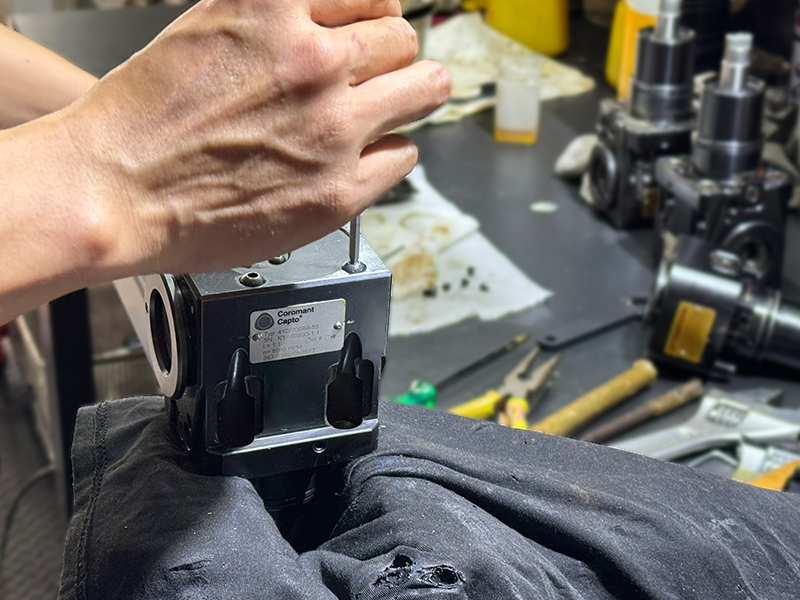
PSC Interface Repair
Product Introduction
Restoring Polygonal Shank Precision and High-Rigidity Clamping Performance
PSC (Polygonal Shank Coupling, complying with ISO 26623 standards, commonly known as Capto compatible systems)
Utilizes a unique tri-lobe polygonal structure. Through a dual positioning mechanism of "taper contact" and "face contact," it achieves high rigidity, high torque transmission, and excellent repeatability.
However, impacts from machine crashes, overloading, or prolonged improper operation can cause irreversible geometric damage to this precision interface, thereby compromising overall machining stability.
Product Description
Product trial model
Common Damage and Restoration
Damage to the Polygonal Shank Contact Surface
If indentations, scratches, localized deformation, or wear appear on the polygonal taper surface, it will directly undermine its:
- Geometric precision of taper contact
- Integrity of face contact
- Original contact rate distribution
Once the contact surfaces are damaged, it will lead to:
- Decreased clamping rigidity
- Reduced torque transmission capacity
- Increased tool runout
- Deterioration of repeatability
The impact of such damage on machining precision is extremely significant and must be repaired using professional equipment.
Failure of Internal Clamping Mechanism
If the clamping claws, springs, or clamping modules inside the PSC tool holder deteriorate due to fatigue or impact, they will fail to provide the specified clamping force, potentially leading to:
- Tool loosening during machining
- Fretting wear on contact surfaces (Frequent Micro-Movement)
- Inconsistent precision
Prolonged neglect will further expand the scope of damage to the taper surface.
Professional Restoration Solutions
The PSC interface is a high-precision geometric coupling system; self-grinding or manual polishing is not recommended.
Any improper machining may destroy the original angles and contact geometry, resulting in permanent errors. Our professional repair process includes:
Precision Taper Grinding and Geometric Reconstruction
- Utilization of dedicated precision grinding equipment
- Micron-level restoration of damaged taper surfaces
- Reconstruction of correct polygonal angles and contact distribution
- Ensuring geometric precision complies with ISO 26623 standards
To restore the original contact rate, clamping rigidity, and repeatability.
Internal Clamping Mechanism Renewal
- Inspection of clamping system integrity
- Replacement of fatigued or damaged components
- Calibration of clamping stroke and clamping force
- Ensuring clamping performance is restored to original factory specifications.
The Key Value of Professional Repair
The core of the PSC system lies in "geometric precision and contact integrity." Professional restoration is not merely a surface treatment; it is a precision reconstruction of the entire clamping geometry. Through standardized repair processes and precision measurement verification, the following can be effectively restored:
- High-rigidity clamping performance
- Stable torque transmission
- Micron-level repeatability
- Machining stability and tool life