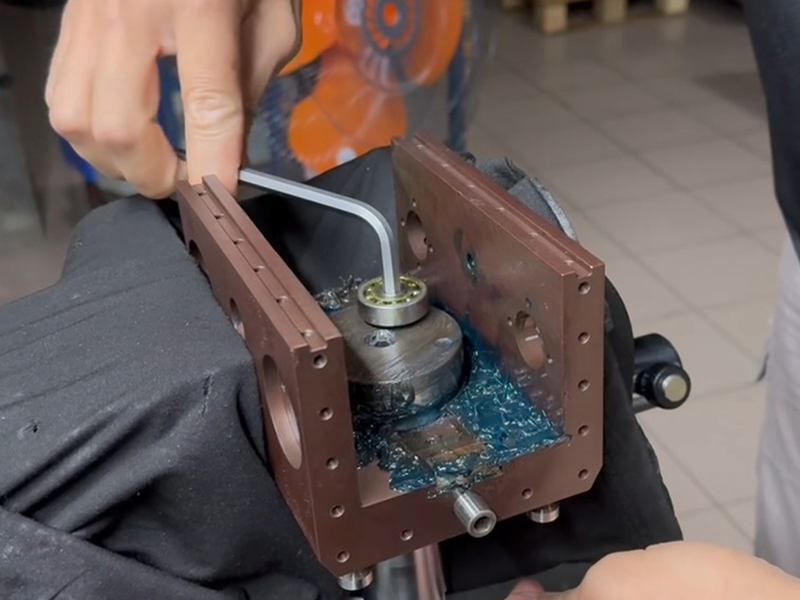
Broaching Tool Holder Repair
Product Introduction
Solving Instability in Broaching and Slotting: Precision Reconstruction of Linear Motion Mechanisms
Broaching / Slotting Tool Holders
These are specialized driven tool holders. Their core mechanism converts the spindle's rotary motion into high-frequency linear reciprocating motion, primarily used for machining internal keyways, splines, and special internal gear profiles.
Because their operation involves periodic high-impact loads, the internal transmission and guiding mechanisms are subjected to long-term repetitive acceleration and deceleration stresses. Compared to standard rotary tool holders, they face a higher risk of wear and mechanical degradation.
Product Description
Product trial model
Common Failures and Mechanism Degradation
Wear of Cams and Sliding Guide Mechanisms The cam and slide rail system inside the broaching tool holder is responsible for precisely converting rotary motion into linear stroke, serving as the core of the overall motion precision. Under long-term high-frequency friction and impact, the following may occur:
- Fatigue-induced spalling on cam surfaces
- Increased clearance in the guide rails
- Uneven wear on transmission contact surfaces
Typical machining symptoms include:
- Obstructed or jerky punch movement
- Inconsistent stroke length
- Increased error in keyway width
- Chatter marks or irregular patterns on the machined surface
Fatigue and Degradation of Return Springs
Return springs undergo continuous high-frequency compression and release cycles, which may lead to:
- Loss of spring force (Elasticity decay)
- Delayed response
- Spring fracture
These issues will cause incomplete punch return or inaccurate positioning, which in turn affects the consistency of machining dimensions.
Key Points of Professional Repair
The key to repairing broaching tool holders lies in restoring the geometric precision and dynamic stability of the linear motion mechanism, rather than simple parts replacement. Our standardized repair process includes:
- Complete disassembly and mechanism cleaning
- Removal of old grease, sludge, and metal debris residue
- Inspection of cam profiles and guiding clearances
- Replacement of worn cams, bearings, and guiding components
- Calibration of linear stroke precision
- Refilling with high-load extreme pressure (EP) grease
Through precision adjustment and testing verification, we ensure that stable stroke and machining consistency are maintained even under high-frequency impact conditions.
Performance Restored After Repair
- Enhanced stroke smoothness
- Improved impact stability
- Increased consistency in keyway dimensions
- Improved machined surface quality
- Extended tool and mechanism service life