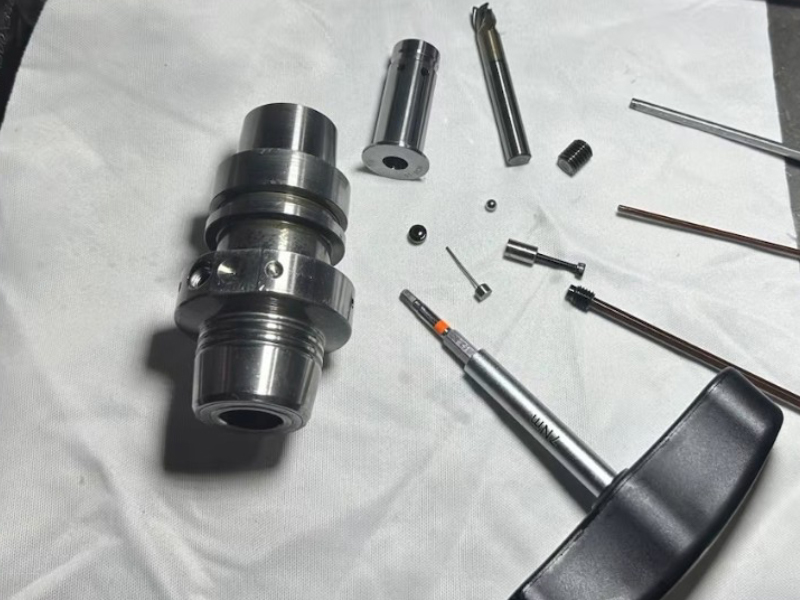
Hydraulic Chuck Repair
Product Introduction
Drop in Clamping Force? Identifying Root Causes from the Hydraulic Sealing System
Hydraulic Chucks
Renowned for their superior runout accuracy (typically within 0.003 mm) and excellent vibration-damping effects, hydraulic chucks are widely utilized in finishing and high-speed machining.
The working principle is as follows:
The tightening screw pushes an internal piston, compressing the hydraulic oil within a sealed chamber. This causes the thin-walled elastic sleeve to undergo uniform radial deformation, thereby generating a stable and concentric clamping force.
This structure relies heavily on sealing integrity and hydraulic pressure stability; any leakage within the system will compromise the overall clamping performance.
Product Description
Product trial model
Common Causes of Failure: Hydraulic System Leakage
The interior of a hydraulic chuck consists of a sealed, high-pressure hydraulic structure. Over time, sealing components (O-rings, gaskets) may exhibit:
- Aging and hardening
- Elastic fatigue
- Wear of sealing surfaces
These issues lead to slow hydraulic oil seepage or the inability to build up sufficient pressure.
Common Failure Symptoms
- Significant drop in clamping force
- Tool slippage or "pull-out" during heavy-duty cutting
- Unstable tool concentricity
- Inability to effectively clamp the tool even when the locking screw is fully tightened
When internal oil levels are insufficient or air is trapped within the system, it will fail to establish stable hydraulic pressure, eventually resulting in a complete loss of clamping function.
Common Misconception: Can simple oil refilling restore performance?
A hydraulic chuck cannot be restored by simply adding hydraulic oil. Attempting to refill the oil without following professional procedures may result in:
- Residual air trapped within the chamber
- Cavitation effects
- Unstable pressure buildup
- Uneven clamping force
The hydraulic system must undergo oil injection and air bleeding under vacuum conditions to ensure complete and uniform pressure transmission.
Professional Repair and Oil Refilling Process
Our hydraulic chuck repair includes a complete sealing and pressure reconstruction procedure:
-
Complete Disassembly and Precision Cleaning Removal of old hydraulic oil, metal micro-particles, and residual impurities to ensure the internal cavity is pristine.
-
Full Replacement of Sealing Components Utilization of original-grade, high-specification sealing kits to restore system hermeticity.
-
Vacuum Oil Injection and Bleeding Injection of specified hydraulic oil using professional vacuum equipment to thoroughly eliminate internal air and reconstruct a uniform pressure state.
-
Pressure and Clamping Verification Testing of clamping pressure and concentricity after locking to ensure performance is restored to within specified ranges.
Performance Restored After Repair
- Stable clamping force
- Micron-level runout accuracy
- Uniform radial clamping deformation
- Enhanced finishing stability
- Extended tool service life